


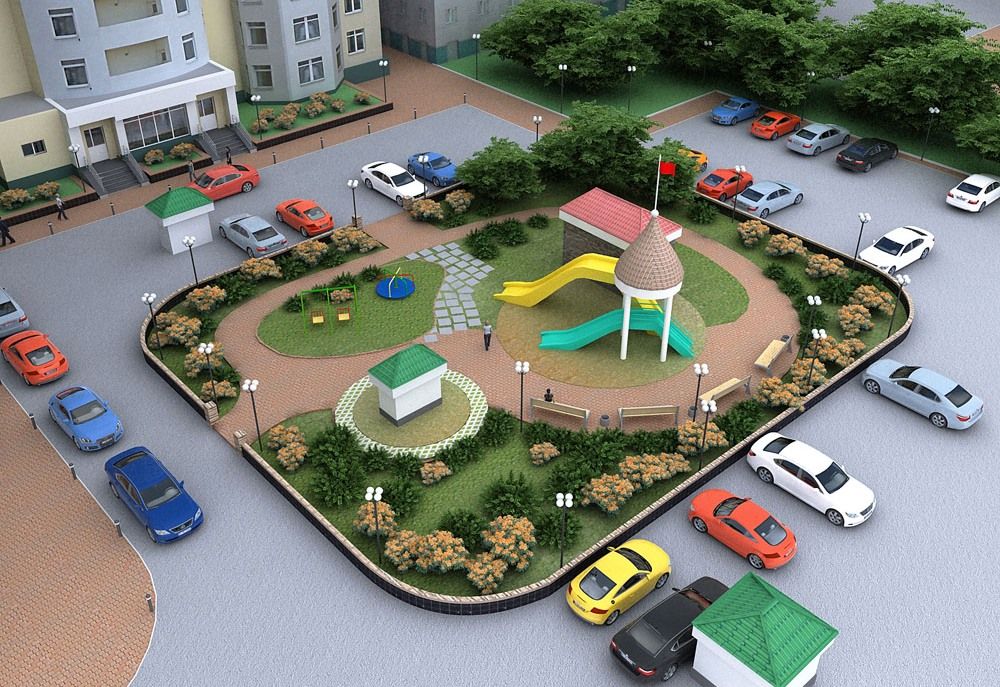
In Bulgarian legislation, there are many texts concerning the concept of “adjacent territories” – the land plots on which buildings, structures, and other objects, including bodies of water, are built.
An earlier but currently valid legal provision, Article 64 of the Property Act (PA), contains an important legal norm: it defines the general right of the building owner to use the land around the building, as well as to the extent that it is objectively necessary to use the building in accordance with its purpose.
This provision, together with the text of Article 38, Para. 1 of the PA (in the part about courtyards), reveals that the legal concept of an “adjacent territory” to a building arises and exists only in one case – on the condition of a separation of ownership between the building and the land plot on which it is built.
It is necessary for the ownership of the land to be the inherited property of one person, and the ownership of the building to be the inherited property of another. In principle, it does not matter whether the building is under a condominium regime, but practical hypotheses about adjacent territories are almost entirely related to urbanized and non-agricultural areas, i.e., adjacent to buildings under a condominium regime (usually residential buildings).
The legislator’s attention is also concentrated on these hypotheses, especially in newer normative acts – the Condominium Management Act (CMA) and Ordinance No. 6 of 18.09.2009 for the determination of adjacent territories to buildings under a condominium regime in areas with complex development (Ordinance No. 6 of 2009). Cases of an adjacent territory to another building on a territory intended for construction are rather an exception. Theoretically, cases are also possible in which only some of the condominium owners have ownership rights to the land, while other owners own only separate units of the building (by law, a transforming right to build). In these hypotheses, we cannot assume that we are talking about an adjacent territory from the point of view of a superficies holder, which we will explain below.
First, let’s differentiate the normative acts on taxation, especially the Local Taxes and Fees Act (LTFA) and the Value Added Tax Act (VATA). The LTFA uses a broader and more indefinite term “land plot” instead of an area, which refers to territories/lands adjacent to buildings and structures only in cases where they are built on agricultural and/or forest land – Article 10, Para. 3 of the LTFA.
In such cases, the law taxes the owners of built-up agricultural and forest plots, while the tax obligation covers precisely the territories adjacent to the buildings and structures. If the adjacent territory is not determined in accordance with the requirements of the law, a presumption is applied that this territory (the adjacent plot and the built-up area) is equal to 10% of the area of the land plot – § 1, item 12 of the Additional Provisions (AP) of the LTFA.
This provision is unclear, which does not prevent municipal administrations from applying it, as they do not make a distinction between the “built-up area,” which is an exact characteristic of the building, and the “adjacent territory” – a separate territory from the building, functionally serving it. In other words, according to this provision, it would be possible for buildings to exist without adjacent territories, because the built-up area may be 10% of the area of the entire property. Cases are also possible where the building completely occupies a specific part of the land plot allowed for construction.
In the hypotheses of the LTFA, there is no need for the building built on an agricultural or forest plot to be the property of a person different from the owner of the land. The VATA also emphasizes a broader meaning of the adjacent territory from a taxation perspective; there is even a hypothesis of transferring adjacent plots to new buildings, as well as the establishment of property rights over such plots – Article 45, Para. 5, item 4 of the VATA.
In reality, adjacent territories cannot be a separate property with the possibility of transferring ownership, but in the described case, the transfer of ownership of a land plot in regulation to persons who have acquired separate units of the building or the right to build is meant. This is usually done after the issuance of a permit for use.
Outside the field of tax legislation, there are a large number of legal norms regarding adjacent territories, which creates a slight inconsistency in concepts or, from another point of view, creates a different character of their legal definition. It is unnecessary to list all the provisions that contain provisions on adjacent territories, but the main ones are the Spatial Development Act (SDA), the CMA, Ordinance No. 7 of 22.12.2003 on the rules and norms for the development of individual types of territories and planning of zones (Ordinance No. 7 of 2003), and Ordinance No. 6 of 2009.
Given the specified normative acts (not including taxation), a generalized conclusion can be drawn that the concept of an “adjacent territory” in the field of planning should refer to territories adjacent to buildings that are built under a complex development regime according to Article 22, Para. 1 of the SDA. In complex development, there must be a group of erected buildings on a large land plot, standing freely or adjacent to each other – § 5, item 23 of the AP of the SDA. In fact, it is important to note that the method of development is determined by a detailed spatial development plan (DSP), a building permit, and an investment project, and not by its external signs. This is also stated by the legal definition in § 1, item 2 of the AP of the CMA – “adjacent territory to a building under a condominium regime” – this is part of the territory of a land plot with complex development, on which a building under a condominium regime is built, and which includes together or separately such objects as green areas, playgrounds, parking lots, and others.”
The concept of an adjacent territory should be distinguished from the property right of ownership to a land plot in regulation. Usually, the adjacent territory refers to existing buildings under a condominium regime (almost always residential property) and is rather a characteristic of the building itself, and not of the ownership right of the persons, while its territory (size of the area) depends entirely on the dimensions of the building (height, length, and width), and not on the number of owners or the total built-up area of each unit.
Furthermore, it can be concluded that in a narrow sense, the concept of an adjacent territory is incompatible with the right of ownership to the land, especially if we have in mind the above definition. The land around buildings under a condominium regime is either a land plot in regulation (on which the building is built), or it is not a separate land plot in regulation. The latter cases were widespread before the adoption of the SDA, even before the entry into force of the Administrative-Territorial Arrangement Act (ATA Act – repealed), they arose during group and cooperative housing construction in accordance with the Planned Development of Populated Areas Act (PDPAA – repealed), which was a kind of precursor to complex construction.
Also, the definition of an adjacent territory, as we said above, makes sense when the owners of the building do not have ownership rights to the land. For the most part, existing residential areas are precisely such cases – buildings are built on state lands, which previously, perhaps, were in regulation, but are now alienated by the state precisely for the construction of residential complexes.
The interests of the former owners were compensated with separate units of the building, but they lost the right of ownership to the land. The problem is that these lands are not regulated in the manner provided by the SDA, and do not have cadastral numbers, which are mandatory according to the Cadastre and Property Register Act (CPRA).
The land was state-owned, its development was possible based on more technical rules and norms. The regulation of real estate operated with respect to private property of citizens (i.e., non-state) through plans of courtyard regulation, while the real estate was called a “plot.”
In accordance with the described factual situation, the legislator set a goal to establish order in residential complexes through the regulation of all land plots on which and around which buildings are built (it would probably be clearer to say residential buildings and dormitories). Although a building is already built on the land, the plots will be defined as separate land plots and entered on the cadastral map and in the registers.
This is implied by the provisions of Article 22, Para. 7, item 2 of the SDA and Article 21, Para. 13 of Ordinance No. 7 of 2003. In the case where the definition of a land plot is not possible in accordance with the requirements of Ordinance No. 7 of 2003, from the adjacent land, a territory is determined that will be an adjacent to the corresponding building. In these cases, a difference appears between the right of ownership to the built-up land plot and the adjacent territory.
If a person is the owner of a separate unit of a condominium building, but does not have the right of ownership to the land, they have the right to use the adjacent plot within the framework necessary for them to use the building unit, regardless of whether the adjacent land plot is in regulation or not – Article 64 of the PA.
A significant difference is the way of using the adjacent plot depending on whether this land is in regulation or is an ordinary “adjacent territory.” Continuing the idea of Article 64 of the PA, owners may wish to use the land in other ways as well. In the case where the land is in regulation, its use depends on the purpose according to the DSP and can be specified by a decision of the general meeting of owners – Article 11, Para. 1, item 10, letter “i” of the CMA.
Along with the purpose, we can also talk about a difference in definition, which, of course, is conditional and insignificant. If the land is not in regulation, the plot around it can be called a typical “adjacent territory.”
If the property is designated as a land plot intended for construction, it would be more accurate not to use the term “adjacent territory,” because the land is not “attached” to the building, but is a completely separate object, and let’s call it the primary one (the land plot), in which there is a building. In fact, the building first appeared (the situation existing before the SDA), and then the land plot appeared, but the idea of the law is to create a natural-legal and logical situation – first, the placement of the land plot in regulation with a specific purpose according to the DSP, and after that, the construction of a building on it. It turns out to be a kind of fiction in the rationality of the law and the practical development of public relations.
The definition of an adjacent territory to existing buildings under a condominium regime is of current importance for real estate and areas with complex development.
It must be borne in mind that whenever possible, the land around the building, and/or on which the building is built, is defined as a separate land plot in regulation according to the rules of the SDA and Ordinance No. 7 of 2003.
Only in cases where this is impossible, the plot is determined as an adjacent territory by an order of the head of the municipality according to Article 4 of the CMA. The above confirms the conclusion about the opposition of the definitions of an adjacent territory and a land plot in regulation. An adjacent territory is located on an urbanized territory in regulation, but it itself cannot simultaneously be a land plot in regulation. If it can become one, it is defined as a land plot in regulation and ceases to be a typical “adjacent territory.” The order is accompanied by a scheme, together with which the boundaries and purpose of the adjacent territory and “the manner and control of its maintenance and use” are determined, and then the territory is provided to the owners of the condominium for its use – Article 7 of Ordinance No. 6 of 2009. The rules for issuing the order are determined by each municipality separately through an ordinance of the municipal council.
The logic of the normative acts probably has greater clarity regarding the status, boundaries, and users of land plots in areas with complex development, i.e., on the entire territory of the areas. A possibility for detailing the purpose of adjacent territories arises, while the rule is noted that the purpose of real estate is limited by an exhaustive list. However they are designated through schemes and even external outlines or signs, adjacent territories cannot be objects of dispositional actions by the owners of the corresponding condominium, as they are not the property of the owners of the separate units of the building.
In a large number of cases, condominium owners cannot have the right to build either, as at the time of the establishment of the right to build (purchase of a dwelling), the limited property right existed and continues to exist only on the built-up area, and not on the subsequently expanded territory through its definition as an adjacent one.
The situation with a land plot in regulation is somewhat different. In fact, typical adjacent territories must be in state or municipal ownership, but again, it must be borne in mind that they can be transferred to the ownership of other persons as well.
An exception is allowed during the reconstruction of residential complexes and in cases of procedures for the transfer of ownership (if it is necessary to transfer municipal land for state needs and vice versa). The provisions of the CMA and Ordinance No. 6 of 2009 seem to be easily applicable in situations with already existing buildings in which all condominium owners do not have the right of ownership to the land. Such cases are quite common, so with the aim of creating the most accurate legal regulation, the provision of Article 4 of the CMA was created along with Ordinance No. 6 of 2009.
However, when the plot is a land plot for construction and is located in an area intended for complex development, or is even a land plot intended specifically for such construction, and is also the property of private individuals, the picture looks somewhat different.
The owners have the full right to use the land as they wish (for example, to increase the area of the parking lot, but they are unlikely to be able to decrease it, or to rearrange a green area into a playground), through the adoption of such a decision at a general meeting according to Article 11, Para. 1, item 10, letter “i” of the CMA. In this case, it is permissible to determine the adjacent territory of each building by the head of the municipality in the manner provided by the CMA and Ordinance No. 6 of 2009.
In fact, in such cases, one cannot talk exclusively about an adjacent territory in its narrow sense, even in the case of a large plot for complex development with 10-15 separate buildings under a condominium regime. The use of the land arises not only from the right of ownership to the separate units of the building but also from the ownership of the land. The latter circumstance prevents the administrative body from determining the adjacent territories and their purpose outside the framework of the DSP.
A similar situation arises when only some condominium owners own ideal shares of the plots for construction, and others – by law, a transforming right to build. Although such a situation seems impossible in practice (in cases of territories with existing complex, i.e., group and cooperative development), in the event of its occurrence, it should be understood that the right of ownership to the land that a part of the condominium owners have, the superficies holders also have.
Superficies is one of the limited real (property) rights to use someone else’s real estate (land plot).
In other words, the head of the municipality will not have the powers to determine adjacent territories only for superficies holders, because they are incompatible with the right of ownership to private land. An illegal encroachment on private property will arise. However, the question remains open whether such a situation actually exists – only a part of the condominium owners own ideal shares of the right of ownership to the land. The CMA does not make a distinction between condominium owners depending on whether they are only superficies holders or also have the right of ownership to parts of the land.
The general meeting consists of the owners of separate units of the building, regardless of whether any of them own the land. Therefore, the possible question of competition and the power of the vote of individual owners (who own or do not own parts of the land) remains unresolved when decisions are made in accordance with Article 11, Para. 1, item 10, letter “i”.
CONCLUSION:
The owner of a building can use the land within the framework that is necessary for the use of the building in accordance with its purpose, with the exception of cases where the act in which this right is granted to them does not regulate otherwise.
During the reconstruction of areas with complex development, adjacent territories to existing buildings are determined according to the rules and norms determined by Article 13, Para. 1, which are regulated as land plots. The rest of the undeveloped part of the areas, including land plots on which it is not yet known whether development will take place according to the rules of Para. 6, is regulated as a green area for broad public use and is entered in the public register in accordance with Article 63, Para. 1.
In existing residential complexes, through restructuring, land plots can be formed and regulated for:
existing residential buildings;
new residential buildings;
objects under Article 17, Para. 1 and 2.
The assertion of the normative completeness of the types of purpose of real estate follows from § 5, item 41 of the AP of the SDA in connection with the CPRA.




Join The Discussion